





Climate control: Weather’s impact on shopping as summer nears
)
Retail WeatherIQ™
The Retail WeatherIQ™ provides weekly weather impact outlooks for select product categories or retail segments compared with the prior year. Learn more.
The arrival of spring means more daylight, warmer temperatures, and the emergence of lawns and gardens. As people look to spend more time outdoors, they are thinking about and purchasing items to support these activities. According to the CNBC/NRF Retail Monitor, powered by Affinity Solutions, April marked the seventh consecutive month of retail sales growth as consumers continued to spend despite weaker sentiment.
Looking at this spending trend through a weather-centric lens, spring weather may contribute to this growth as it continues to influence consumer purchasing. For many retailers, spring represents a highly volatile period, and, unlike the winter holidays, the consumer is more sensitive to small changes in weather.
Weather sensitivity — the percentage of sales affected by the weather in a typical year — is particularly high for lawn and garden categories as well as warm weather apparel (shorts, sandals) and traffic into restaurants and outdoor shopping and entertainment destinations.
In fact, early spring is the most weather-sensitive time of the year for many seasonal categories such as sandals, short and allergy relief.
Spring weather update, outlook and retail impacts
The spring selling season experienced a favorable start for warm weather categories. February in the United States was the warmest since 2024 and the driest since 2006 — although the East Coast was still battling with notable cold and snow. March was the warmest since 2012 and driest since 2021, continuing to send a signal to the consumer that spring is here.
The warmer and drier conditions compared with the prior year have supported demand for seasonal categories as well as help lift foot traffic into retailer stores and shopping destinations. Early season spikes in demand have helped to increase sales and profitability. The Retail WeatherIQ shows that the impact of weather on seasonal purchasing in March was favorable compared with last year.
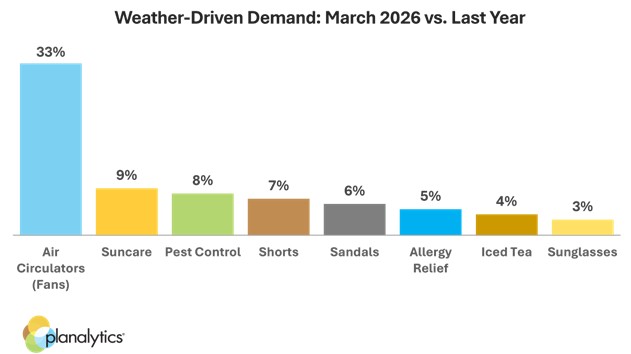
Weather-driven demand values represent the estimated % change in demand of the product/category based purely on year-over-year changes in weather.
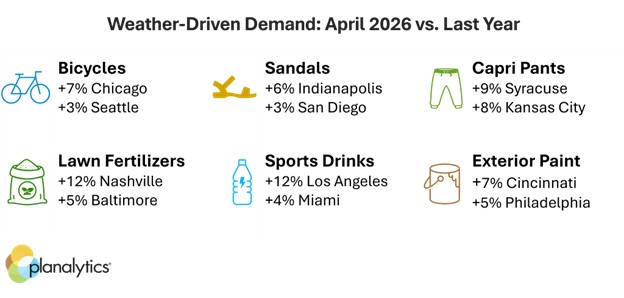
April 2026 was warmer than normal, although slightly cooler than last year. It featured some record-breaking temperatures in the middle of the month in large population centers including New York City. Warm temperatures drove need-based purchasing as well as helped spur discretionary spending. Nationally, it was the driest April since 2008, which helped increase foot traffic into shopping destinations. Early season spikes in demand, particularly for seasonal goods, helped contribute to sales and profitability gains for businesses.
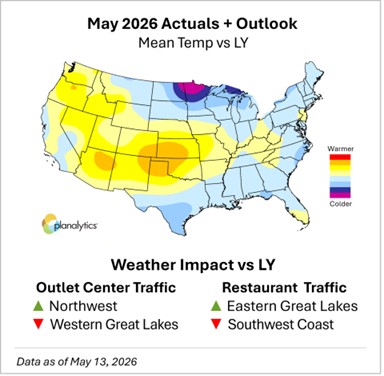
May is showing regional warm-weather opportunities compared with last year, focused in central regions and the Northwest. We are also experiencing a drier May compared with last year, which was the wettest since 2019, helping support foot traffic into many retail stores, restaurants and shopping centers.
Severe weather
Springtime also features severe weather, which has seen higher-than-normal levels as of April — though not as extreme as last year — and June marks the beginning of the 2026 Atlantic hurricane season. Last year featured 13 total storms, although it was the first time in 10 years the U.S. did not have a landfalling hurricane.
Retailers should have operational plans in place to execute against when severe weather hits or is projected to occur. This helps to not only ensure the safety and protection of employees and facilities, but it also enables businesses to meet the need-based demand of customers at critical times.
While you can’t control the weather, you can control how it affects your business. Retail WeatherIQ, created in partnership between NRF and Planalytics, provides weather-driven demand insights to improve both strategic and tactical functions of a business, enabling retailers to have a proactive approach to assessing and addressing the impact of climate and weather.